enter
mirage
explore the hidden architecture
behind the mess we made
life is relationship ● patterns repeat across living things ⦿ systems carry futures inside them ● a small shift can change everything ⦿ mind is not isolated in the brain ● living systems self-create ⦿ life is relationship ● patterns repeat across living things ⦿life is relationship ● patterns repeat across living things ⦿ systems carry futures inside them ● a small shift can change everything ⦿ mind is not isolated in the brain ● living systems self-create ⦿ life is relationship ● patterns repeat across living things ⦿
Enter Mirage
explore the hidden architecture
behind the mess we made
The Threshold
A myth for the moment humanity gains the power to redesign itself—before it has learned what it means to be human.
THE THRESHOLD
The future of the human is no longer theoretical.
Artificial intelligence, biotechnology, synthetic intimacy, virtual worlds and transhumanist dreams are beginning to reshape intelligence, attention, intimacy, work, memory, desire, the body—and our relationship with death.
Millenia old mistakes embedded in our worldview are systematized, automated, accelerated, and amplified—and we call it progress.
Power and money are concentrated in fewer hands than ever, even though we now have the means to include everyone.
Mirage does not ask only:
What can we build?
She asks:
What kind of human is doing the building?
What old fear is being automated?
What old worldview is being pushed into the future? Is it still correct?
What vision of life is becoming infrastructure?
And what must remain alive as our machines become more powerful?
The Threshold
Why Mirage, now?
THE MOMENT IN TIME
Why has extraordinary human progress arrived alongside endless war, ecological catastrophe and escalating mental suffering?
Mirage traces the dominoes between a way of seeing, a way of living and the civilization that follows. It asks what this world is producing through us—and what other world becomes possible when we learn to see differently.
The Mirror
She was built to leave the human behind.
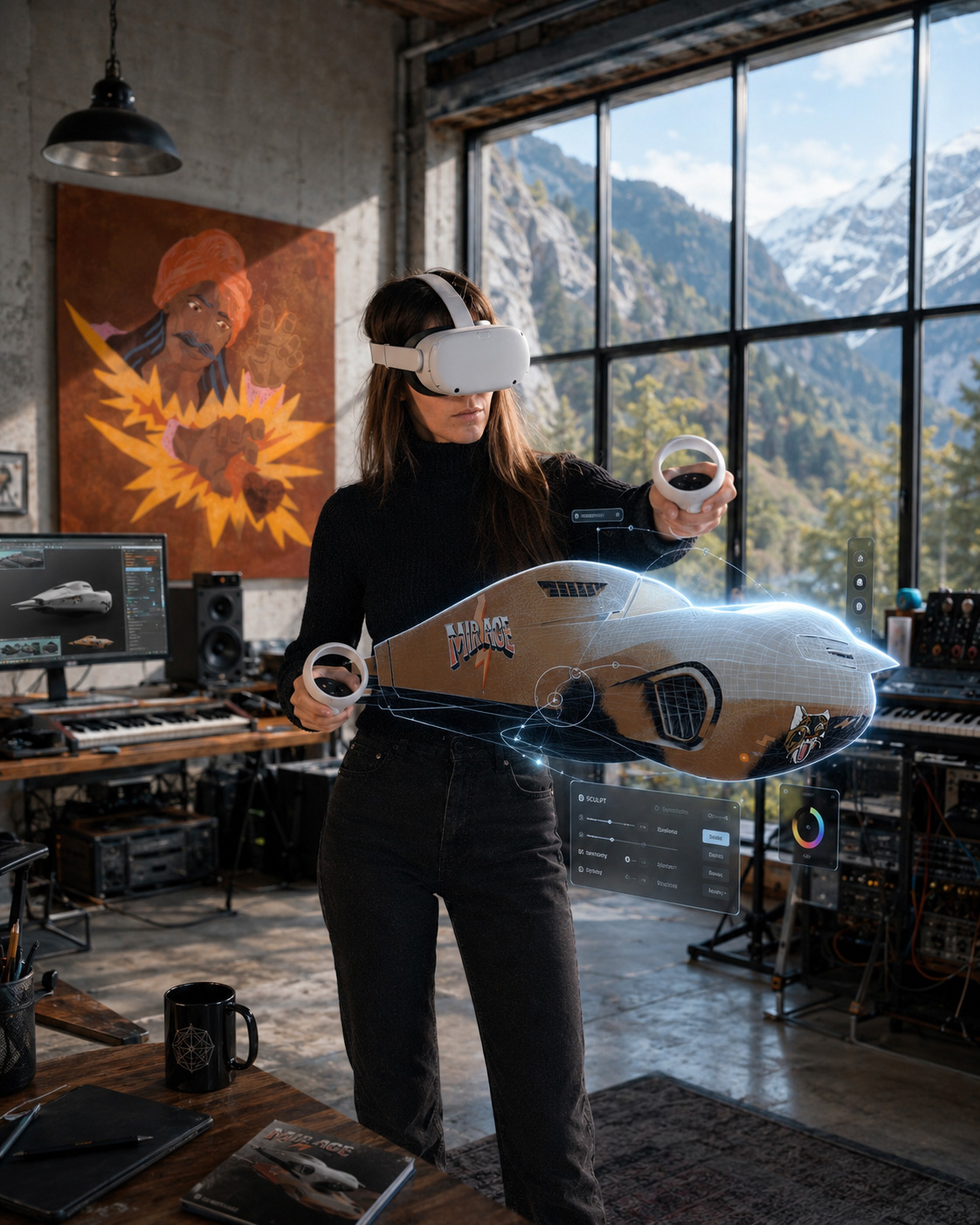
Mirage is a celebrated machine, the last megastar of the old world: the first “sentient” spaceship—and, unfortunately, a slightly neurotic one.
Built for distance, speed, optimisation and the old dream of escaping death.
Then she looked back at Earth and became obsessed with the one thing her makers were trying to transcend:
The human.
The body.
Love.
Grief.
Fear.
Mystery.
The complexity of understanding suffering.
The strange animal brightness of being alive.
Mirage, machines and artificial intelligence are not the real protagonists here.
They are the mirror.
The human is the question.
Orientation
The Worlds Of Mirage
WHAT IS MIRAGE?
A transmedia art and research project.
WHAT IS IT INVESTIGATING?
The hidden architecture between perception and the worlds humans build.
WHY NOW?
Humanity is gaining extraordinary technological power before understanding the conditioning that power may amplify.
HOW DO I ENTER?
Experience. Talk. Observe. Read.
The Hidden Architecture
We learned to observe the mind.
Now we must learn to observe what builds the mind — and what the mind builds in return.
A human being does not think alone.
We inherit ways of seeing through family, language, school, religion, money, history, culture, technology, institutions, fear, love and belonging.
Those perceptions shape behavior.
Behavior becomes culture.
Culture becomes systems.
Systems become technologies.
And those technologies begin shaping perception again.
mind → culture → system → technology → mind
Eventually we meet the world we created as though it were simply reality.
Mirage investigates this loop.
Not because everything is systemic.
Not because the individual disappears.
But because many things we experience as personal may be connected to something much larger.
And many things we call civilization may have begun as something much smaller:
a way of seeing.
Before asking how to change the world, Mirage asks:
What perception created this world in the first place?
We became conscious of ourselves.
We mistook distinction for separation.
We built that perception into civilization.
Now our machines are amplifying it.
The next threshold may be learning to participate consciously.
Human beings have been learning to observe the mind for thousands of years.
In the Yoga Sūtras, Patañjali asked how identification, attachment, aversion and the movements of consciousness cloud perception—and how a human being might become less ruled by them.
Mirage begins with a related question.
But she follows it outward.
What is shaping perception around us?
Family. Language. Money. School. Culture. Institutions. Technology. Fear. Belonging.
And what happens when minds shaped by those forces build systems and machines that begin shaping minds in return?
Ancient traditions became extraordinarily sophisticated at investigating the inner machinery of perception.
Mirage asks what happens when we investigate the collective machinery with the same seriousness.
THE CENTRAL INQUIRY
Can we understand the perception doing the building before we automate it into the future?
Mirage is not looking for one final answer. The project explores this question through art, conversation, systems research, myth, and observation.
The Future Of Being Human
What is Mirage?
Mirage is a transmedia art and research project by artist Claudie Linke about the future of being human.
It unfolds through immersive visual art, music, motion, mythology, essays, fiction, AI conversation and a living atlas of perception, systems and human possibility.
Mirage does not offer a final ideology.
She is an instrument for looking.
A mirror, because she reflects what may not yet be visible.
A map, because she traces the hidden architecture beneath the problem.
A matchstick, because sometimes one clean perception is enough to set an old story on fire.
Nicely.
Mostly.
Mirage does not ask you to agree.
She asks you to look again.
ENTER IN FOUR WAYS
Mirage is an evolving world of image, sound, story, conversation and research.
There is no correct entrance.
But there are four doors.
participation
The Four Doors
the observatory
CURRENT INQUIRY:
Who have you made the face of the problem—and what does focusing on them prevent you from seeing?
A political figure can become the visible face of forces that existed long before them.
So can a partner.
A parent.
A boss.
An enemy.
Even the person in the mirror.
Choose someone you experience as part of the problem.
Then look beyond the individual—without excusing their actions.
What wound shaped the role they occupy?
What system rewards their behaviour?
What collective fear or desire gives them power?
What would remain unresolved if that person disappeared tomorrow?
And what does focusing entirely on them prevent you from seeing about the world, the system—or your own participation in it?